In short
Lingo has three modes, chosen in the game options: Classic, Bingo and Tournament. This guide starts with Classic and then covers the other two.
In Classic you have a card of 16 numbers. Each turn a word appears. If its letters can be combined with + − × ÷ to make one of the numbers on your card, tap that number to cross it off. Score for every number, and for every row, column and full card you complete.
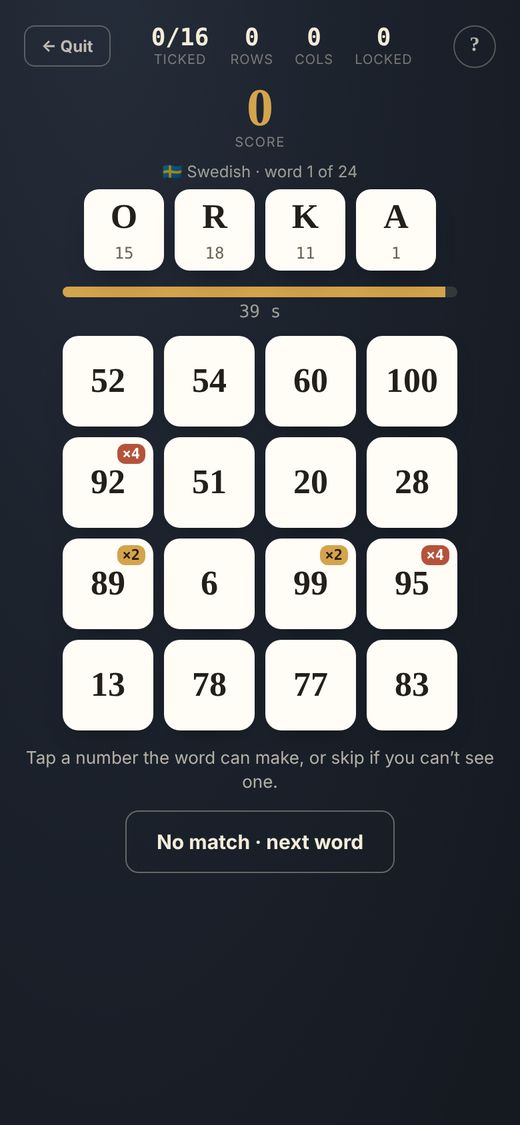
Your card
The card is a 4×4 grid of 16 different numbers between 1 and 100. Some numbers carry a ×2 or ×4 badge: these are the hardest numbers to make, so they are worth more.
Words and letter values
Every word has four letters, and each letter is worth its place in the alphabet: A=1, B=2 … Z=26. The values are shown under each letter. Other languages use their own alphabets, so letter values can differ; the General guide lists them.
Making a number
Put a sign between each pair of letters, in order, using + − × ÷. Multiplication and division are worked out first (BIDMAS), and a division must come out exactly, with no remainder.
20 + 9 + 13 × 5 = 20 + 9 + 65 = 94
20 − 9 + 13 × 5 = 76
HOME = 8, 15, 13, 5
8 + 15 × 13 ÷ 5 = 8 + 39 = 47
A word can often make more than one of your numbers. Tap whichever you spot. You don’t have to enter the sum, just tap the number: the game shows you the working afterwards.
Classic: one try per word
- Each word gets one tap. A correct tap crosses the number off in green.
- A wrong tap scores nothing and locks that number in red for the rest of the game, so you can’t use it later.
- If you can’t see a match, press No match · next word. Skipping costs nothing and locks nothing. (Not every word fits your card.)
Classic: scoring
- 1 point for each number crossed off.
- +4 for each row or column you complete.
- +16 for a full house (all 16 numbers).
- A ×2 or ×4 number multiplies everything you score on that turn, bonuses included. Finish a row or the full house on a ×4 number and it’s a big turn.
Classic: the clock
There are 24 words in a game. Before you start, choose how long you get per turn: 20, 30 or 40 seconds.
- The clock is a time bank. You start with one turn’s worth of time. Each time you tap a number or skip, whatever time is left carries over and a fresh turn’s worth is added, so quick answers build up a reserve for harder words.
- If the clock runs out, the game ends. You can only move on to the next word by tapping a number or skipping. You keep the score you have so far.
Classic: the words
Pick one language, or all twelve mixed together (polyglot). Words are common ones from the 4Sums word lists, and none repeats within a game. Of the 24 words, 16 are guaranteed to make one of your numbers each (a different number every time), and the other 8 are random, so some will fit and some won’t.
Your best score is saved for each combination of seconds per turn and language.
Bingo mode
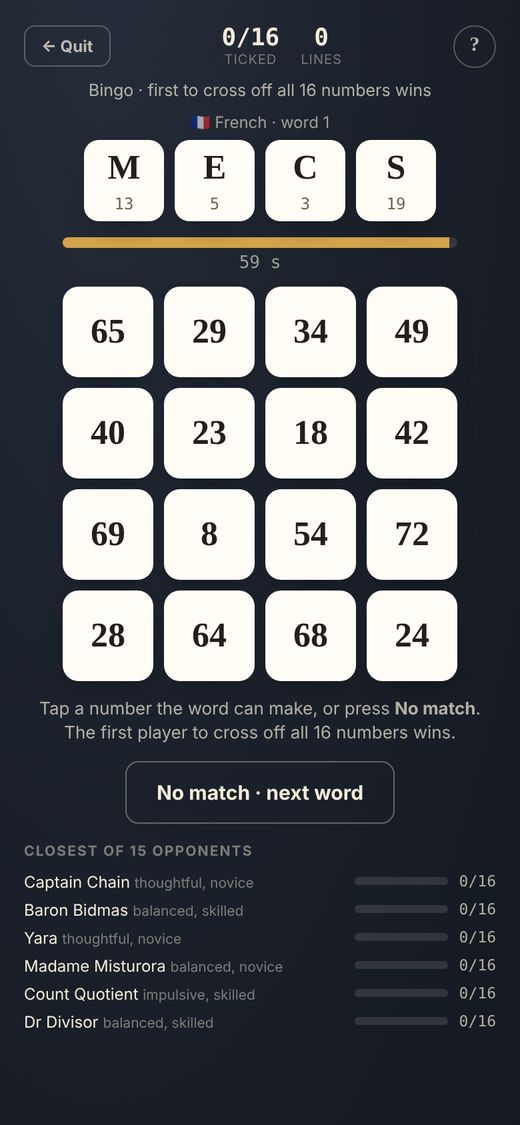
Pick Bingo in the game options for the pure bingo game. One word at a time is called to you and to 15 computer players, who each have their own card of 16 numbers. There are no multipliers and no limit on the number of words: they keep coming until somebody has crossed off all 16 numbers, and the first to do so wins.
- Each word stays up for 40, 60 or 80 seconds (your choice). Tap a number it can make, or press No match to move on. If time runs out the word simply passes.
- A wrong tap costs you that word only. It does not lock the number, because you could never finish a card with a locked number.
- Each computer player has a knowledge level (novice, skilled or expert) and a personality (balanced, impulsive or thoughtful), chosen at random. Novices miss words and sums; experts rarely do. Impulsive players answer fast but slip more; thoughtful players are slower and never slip. If two players finish on the same word, the faster one wins.
- As in real bingo, you can’t see how the other players are getting on. The suspense is part of the fun: you only find out when somebody is the first to complete a line, the first to complete two lines, or completes the card (the first two earn no prize in plain Bingo; they are just announced).
Tournament mode
Pick Tournament to play a series of bingo games for counters against the same 15 computer players. Choose how many counters everyone starts with (10, 20 or 40) and the number of rounds (4 to 8). Before every round each player chooses their own bet, from 2 to 8 counters; the computer players bet according to their personality (thoughtful players bet low, impulsive ones high).
- Every round each player puts their bet into the pot, so the pot is bigger when players bet bravely.
- The first player to complete a line (a row or a column) wins 10% of the pot.
- The first player to have two lines wins 20% of what is left.
- The first to the full house takes all the rest, and the round ends.
- Winnings add up over the rounds in the leaderboard. The player with the most counters after the last round is the champion. If you have fewer than 2 counters left you sit out the remaining rounds.
Learn along the way
Lingo is a workout for mental arithmetic and for estimating which numbers a word is likely to make. Bingo and Tournament modes add a little probability: how likely is it that the next word helps your card, and how much should you bet?
Watch a playthrough
An explained playthrough of Lingo: crossing numbers off the card with the words.
Order of operations, word lists and alphabets are explained in the General guide.